
Home > UK Home Improvements Study 2026

UK Home Improvements Study 2026

1st October 2026 | Published by Kirsty Bannister

The UK Home Improvements Report: How Much Are Homeowners Spending, Saving & Borrowing to Upgrade in 2026?


  • 61% of survey respondents would rather improve their home than move
  • 67% (over two-thirds) of respondents have delayed a home improvement because they couldn’t afford it
  • Most respondents think they’d need between 20-50k for their dream renovation, but only a third have dedicated home improvement savings
  • The average value of an approved home improvement loan has increased by 120.5% over 9 years
  • Applications for home improvement loans between £20,000 and £29,999 rose by 13% in 2025 compared to 2024


According to the Evolution Money 2026 UK Home Improvements Report, two-thirds of the 2000 surveyed UK homeowners have delayed home improvements because they couldn’t afford them.

Internal Evolution Money data from January 2026 to July 2026 also shows demand for home improvement loans continues to grow.

Although inflation has eased from its 11.1% peak in 2022, higher prices have left many UK homeowners with less disposable income and reduced capacity to save. Meanwhile, house prices remain high, which makes moving home too expensive for many. These economic pressures are changing how homeowners invest in their properties, with many choosing to renovate rather than relocate.

To explore how these economic conditions are shaping home improvement decisions, Evolution Money combined nationally representative consumer research with internal lending data and analysis of average UK renovation costs. The study examines how homeowners are funding renovations, whether project costs are changing consumer behaviour, and why demand for home improvement finance continues to grow.

The findings reveal a widening gap between what homeowners have saved and what modern renovations actually cost. While many homeowners would rather improve their existing property than move, the cost of doing so is increasingly outpacing their ability to save, leading more people to delay projects or take out home improvement loans to bridge the shortfall.


61% of UK homeowners would rather improve than move

The research found that 61% of homeowners would prefer to improve their existing home rather than move over the next five years, compared with just 19% who would choose to relocate.

Among those choosing renovation over relocation, the most common reasons were:

  • 61% like their current home and neighbourhood
  • 42% believe moving costs are simply too expensive
  • 42% say the stress and disruption of moving puts them off
  • 41% believe house prices are too high


The findings reflect a growing trend towards investing in existing homes rather than entering an increasingly expensive housing market.
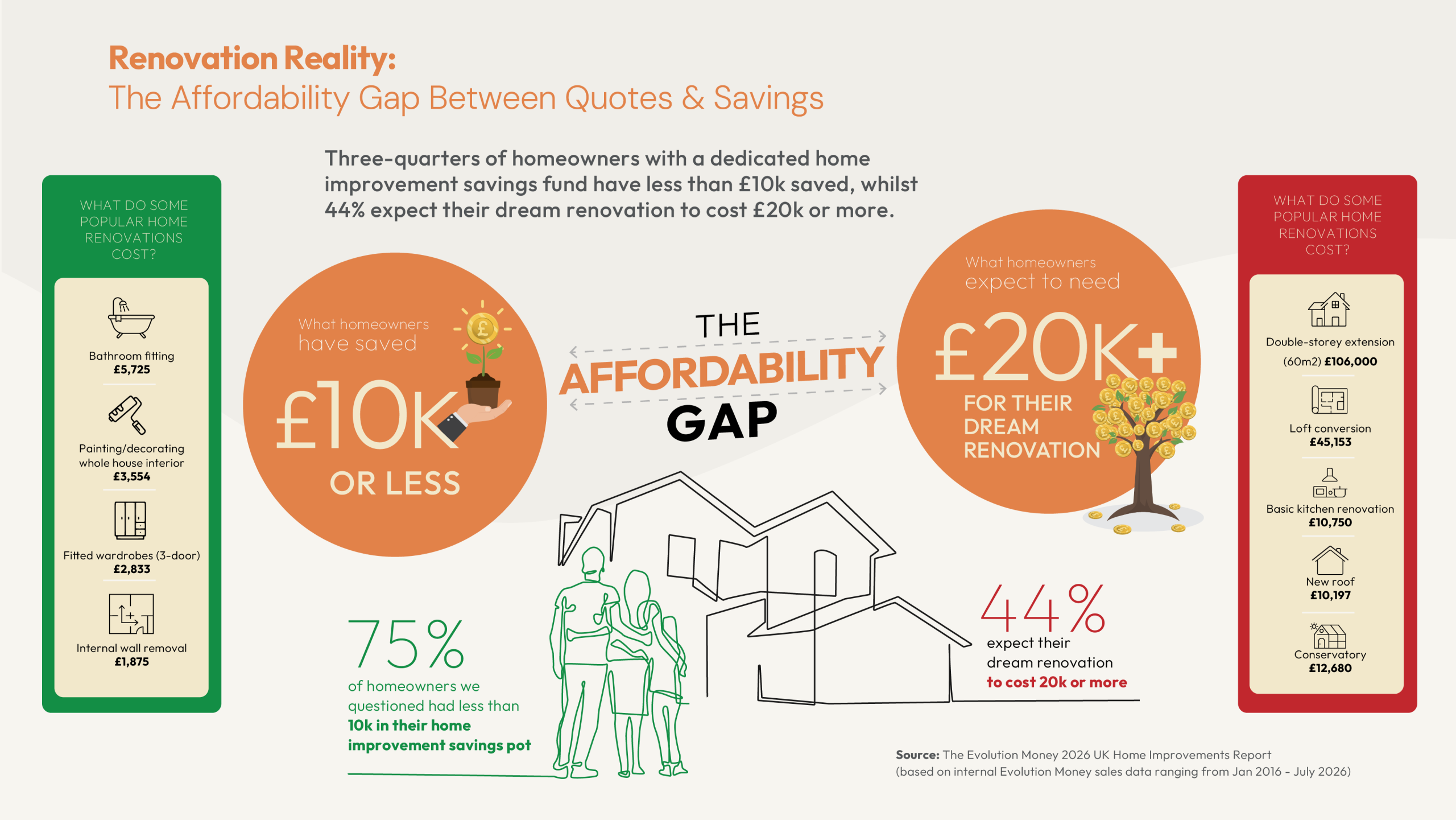
 

The UK has a home improvement funding gap


Although 50% of homeowners say they would use savings to pay for a major renovation, only 34% have actually built a dedicated home improvement fund.

Among those with savings:


Amount saved Share of respondents
Less than £5,000 46%
Less than £10,000 75%
More than £20,000 10%


Yet homeowners believe they need substantially more to complete their ideal projects. The most common estimate for a dream renovation sits between £20,000 and £49,999, while 70% believe they’ll need at least £10,000.

This highlights a significant funding gap between what households have available and what modern renovations now cost.

Kerri Pender, Managing Director at Evolution Money, offers her advice on planning and saving for home improvement work:

“If you’re planning a renovation, it’s best to build a dedicated fund before work begins. While the amount you’ll need will depend on the scale of the project, having enough to comfortably cover your expected costs – and thinking about setting aside a contingency for unexpected expenses – could make a huge difference. Renovations, particularly in older properties, often uncover issues that simply aren’t visible until work is underway, so budgeting for the unexpected is just as important as budgeting for the project itself.”


Most homeowners’ savings would only cover small renovations

The research compared homeowners’ savings with average UK renovation costs and found that many households could comfortably afford only relatively modest improvements.

Typical projects that could be completed with savings below £5,000 include:

  • Painting and decorating: £3,554
  • Decking installation: £3,033
  • Fitted wardrobes: £2,833
  • Bathroom tiling: £841
  • Fencing: £1,249
  • EV charger installation: £950


However, many of the country’s most popular improvements now exceed this level of savings, including:

  • Bathroom renovation: £5,725
  • Central heating installation: £5,050
  • New boiler: £6,017
  • Solar panels: £7,187
  • Replacement windows: £8,925
  • Air source heat pump: £9,125
  • Kitchen renovation: £10,750
  • Loft conversion: £45,153
  • Double-storey extension: £106,000


The findings demonstrate how even relatively common renovation projects are increasingly beyond the savings held by many households.


Energy efficiency is a priority, but the upfront cost is holding homeowners back

75% of homeowners say they would consider carrying out improvements specifically designed to reduce energy bills.

However, many energy-efficient upgrades require substantial upfront investment:


Improvement Average cost
New boiler £6,017
Solar panels £7,187
Air source heat pump £9,125
Underfloor heating £9,570

For homeowners with less than £5,000 saved, these upgrades remain financially out of reach despite strong demand.

Kerri Pender says:

“For homeowners whose savings don’t quite stretch to larger improvements, the key is to have a realistic plan. That might mean tackling the work in phases, prioritising the upgrades that will have the biggest impact on your home’s comfort or energy efficiency, or considering finance as part of a carefully planned budget rather than a last resort. The most important thing is ensuring that any borrowing is affordable and supports a renovation that adds long-term value to your home and the way you live in it.

Improving your home’s energy efficiency is often a worthwhile investment, as you may save money in the long run by reducing your energy bills. Research shows that 34% of people who undertook home improvements in 2025 made green improvements, such as adding solar panels or insulation.”


The home improvement funding gap is leading to renovations being delayed

Affordability is already affecting homeowners’ renovation plans.

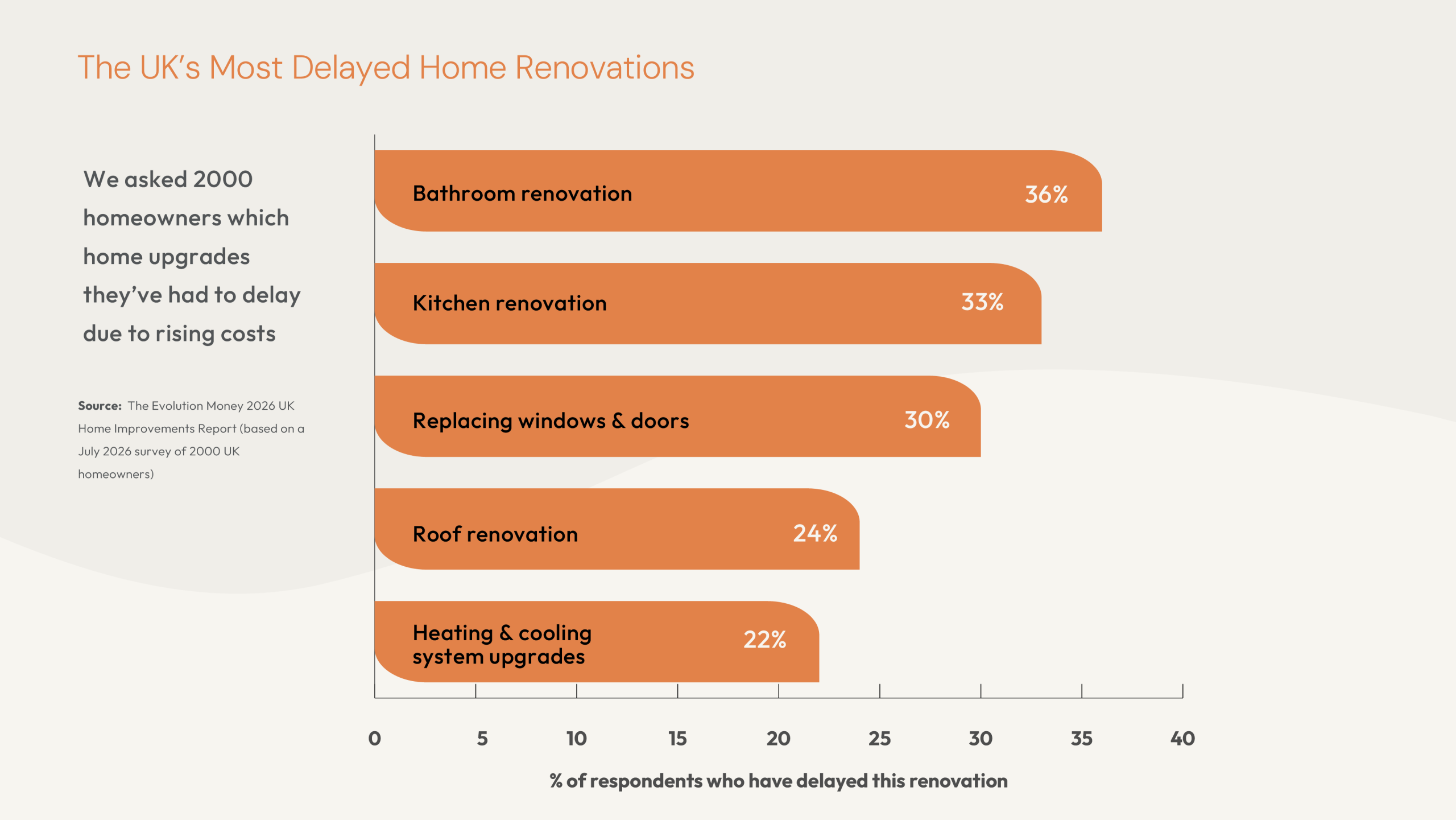
Overall, 67% say they have delayed a home improvement because they couldn’t afford it, with 39% postponing multiple projects.

The most frequently delayed improvements include:

Project Delayed by Average cost
Bathroom renovation 36% £5,725
Kitchen renovation 33% £10,750
Windows and doors 30% £8,925
Roof renovation 24% £10,197
Heating upgrades 22% £5,050

Notably, these projects generally fall within the £5,000-£11,000 price range, the bracket that exceeds the savings held by almost half of homeowners with dedicated renovation funds.

A recent study by Nationwide found that extensions and loft conversions increase property value by up to 24%, which means homeowners who have to delay their projects could lose out when it comes to selling their homes.


Borrowing is increasingly helping homeowners bridge the funding gap

Evolution Money’s lending data suggests growing numbers of homeowners are turning to finance to complete large renovation projects.

Applications for home improvement loans increased by 7% between 2024 and 2025, while the number of approved loans has more than doubled since 2021.

Demand remains strongest for loans below £20,000, which account for almost three-quarters of applications. However, borrowing is steadily shifting towards larger loan values.

Applications between £20,000 and £29,999 grew by 13% year-on-year in 2025, making it the fastest-growing mainstream borrowing bracket.

Applications for loans above £100,000 increased by 29% year-on-year. However, this should be interpreted in the context of Evolution Money only recently introducing lending above £100,000, meaning comparisons with earlier periods are influenced by the expanded product range.


The amount being borrowed per loan is increasing over time, reflecting higher costs

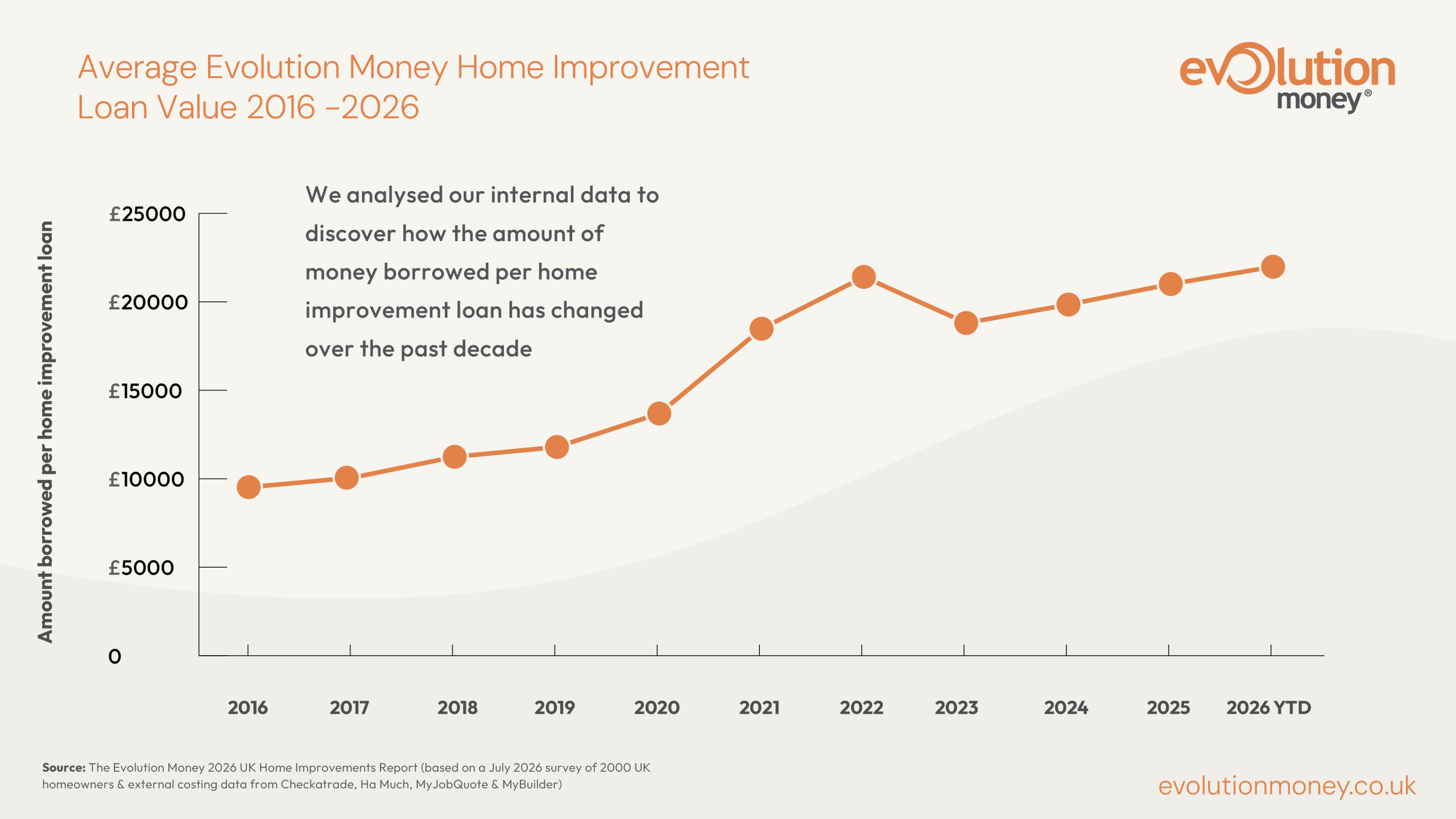
The average home improvement loan has increased dramatically over the past nine years.

Average approved loan values rose from £9,527 in 2016 to £21,005 in 2025 – an increase of 120.5%.

Meanwhile, Evolution Money’s total annual lending for home improvements increased from £5.5 million in 2016 to more than £24.1 million in 2025.

The average loan issued since 2022 stands at £20,409, closely matching the amount homeowners believe they need for their ideal renovation.

Borrowing has also remained concentrated among homeowners aged 35-54, who account for approximately 62% of all funded home improvement loans where age is known.
 

What can we take away from this research?

Kerri Pender concludes:

“Our research paints a clear picture of how the UK’s home improvement market is evolving. Homeowners still have a strong appetite to invest in their properties, but the financial landscape has changed considerably over the past few years. Rising inflation, higher material and labour costs, and the wider cost of living have all made it much harder for households to build the level of savings needed for major renovation projects. At the same time, moving home remains an expensive option for many, meaning more people are choosing to improve the homes they already have instead.

“That combination of factors is creating a growing funding gap. Our findings show that while many homeowners aspire to undertake larger renovations, the amount they’ve been able to save often falls well short of what those projects now cost. As a result, we’re seeing more homeowners carefully weighing up their options, whether that’s phasing work over a longer period, prioritising the improvements that matter most, or using finance to bridge the gap.

“The growth we’ve seen in both home improvement loan applications and average borrowing values reflects this changing behaviour. For many homeowners, finance has become an important way to carry out meaningful improvements without having to postpone their plans indefinitely or move house altogether. When used responsibly and as part of a well-planned budget, borrowing can help homeowners invest in projects that improve the comfort, energy efficiency and long-term value of their property.”


Methodology

The data for this campaign was collected from 3 sources:

  • A survey of 2000 UK-based homeowners aged 18-99
  • Third-party cost data collected from sites incl. CheckaTrade
  • Internal data from Evolution Money


Here’s a more detailed breakdown of each method:

Survey methodology:

  • The survey data was collected using Pollfish in July 2026.
  • The demographics were 2000 UK residents who owned a property, aged between 18 and 99.
  • Detailed audience: Country: United Kingdom, Age: [18 – 24], [25 – 34], [35 – 44], [45 – 54], [55 – 64], [65 – 99], Gender: Male, Female, Type of Home: Owned apartment, Owned Single Family Home, Owned Multi-Family Residence (Duplex, Triplex), Farm
  • The survey questions (and answers) can be found here.


3rd party data methodology:

  • Costing data was collected from the following sites:
    1. CheckaTrade
    2. Ha Much
    3. My Job Quote
    4. My Builder
  • Each of these sites regularly updates their guides on the average cost of a wide range of home improvements (no guide used was updated any earlier than March 2026).
  • Costing data for each home improvement was collected from these guides, and then a mean average was taken to achieve the overall average cost.
  • Example guide: https://www.checkatrade.com/blog/cost-guides/cost-double-storey-extension/

All home improvement cost data


Improvement

Cost (£)

Double-storey extension (60m2) £106,000
Loft conversion (30m2) £45,153
Single-storey extension (20m2) £37,000
Whole house plumbing replacement (2 bed) £14,750
Garage conversion (16m2) £13,875
Conservatory (3.5m x 3.5m) £12,680
Basic kitchen renovation £10,750
New roof £10,197
Underfloor heating installation (96m2 house) £9,570
Air source heat pump £9,125
Replacement windows (3-bed house or 12 medium uVPC windows) £8,925
Solar panels (4kW photovoltaic (PV) system, suitable for a 2-3 bedroom house) £7,187
Patio (20m2) £6,125
New boiler (boiler & installation) £6,017
Rewiring (whole home – 3 bed) £5,931
Bathroom renovation (fitting excluding plumbing) £5,725
New driveway (60m2) £5,550
New flooring (96m2) £5,330
Central heating installation £5,050
Laying new turf (244m2 garden – UK average) £4,473.33
Painting/decorating whole house interior (96m2) £3,553.75
Decking installation (15 – 30m²) £3,033.33
Fitted wardrobes (3-door) £2,833
Downstairs bathroom installation £2,474
New staircase (average straight wooden staircase with pine banister) £2,399
Internal wall removal £1,875
Fencing (15m garden length) £1,248.5
EV charger installation (without a government grant) £950
Internal plastering (medium-sized room) £923.75
Tiling a bathroom (9m2) £841.25
New carpet (17.5m2) £769
Painting/decorating day rate £225.5


Data caveats: every action was taken to attempt to standardise the data from the 4 sources. Each source priced the renovations slightly differently – for example, some included labour costs in their averages, whilst others didn’t. The sources also used various scales to achieve their averages. For example, whilst one based averages on a ‘three-storey house’, others would base it on the square footage. To attempt standardisation, the average size of various rooms, houses & gardens was assumed, as follows:

  • Average square footage of a double storey extension: 60 m2
  • Average square footage of a single-storey extension: 20 m2
  • Average UK house size: 92m2
  • A three-bed house is assumed to have 12 windows
  • Average driveway: 60m2
  • Average UK garden size: 244 m2 and 15 m length
  • Medium-sized decked area: 15 – 30m²
  • Average living room size: 17.5m2

It’s important to note that all average prices and estimates and shouldn’t be seen as precise.


Internal Evolution Money data methodology:

The following data was supplied by the internal data team at Evolution Money Group:

  • The average amount that was borrowed for home improvement loans YoY from 2016 to 2026 Y2D (July 2026).
  • The % of total Evolution Group customers borrowing for home improvements from 2016 to 2016 Y2D (July 2026).
  • The age breakdown of the customers taking out the home improvement loans from 2016 to 2016 Y2D (July 2026).
  • The total amount of home improvement loans applied for and accepted from 2016 to 2016 Y2D (July 2026).
  • The amount of applications for home improvement loans received per month for 2024-25

Evolution Money’s lending range expanded in 2025 to include loans above £100,000. While this has contributed to an increase in average loan values, the underlying trend of larger borrowing amounts predates the product expansion, with average home improvement loan values more than doubling between 2016 and 2025.

It should also be taken into account that Evolution Money’s reporting systems underwent improvements in 2021 with the introduction of a new system.

All 2020 data should be viewed as an anomaly due to the COVID-19 pandemic.

Category: Evolution Money Press Release, Money
This post was written by Kirsty Bannister
Warning: Late payment can cause you serious money problems. For help, go to moneyhelper.org.uk

Representative 21.82% APRC (Variable)

For a typical loan of £18,900 over 180 months with a variable interest rate of 18.72% per annum, your monthly repayments would be £335.99 for 179 months and then a final payment of £335.79. This includes a Product Fee of £1890.00 (10% of the loan amount) and a Lending Fee* of £763.00, bringing the total repayable amount to £60,478.00. Annual Interest Rates range between 8.6% to 27.87% (variable). Maximum 50.00% APRC. *Lending Fee varies by country: England & Wales £763, Scotland £1,051, Northern Ireland: £1,736.


Think carefully before securing debts against your home. Your home may be repossessed if you do not keep up repayments on your mortgage or any other loan secured against it. If you are thinking of consolidating existing borrowing, you should be aware that you may be extending the terms of the debt and increasing the total amount you repay.


© 2026 Evolution Money | Cookies | Terms & Conditions | Fair Processing Notice
Start Here
Please wait

Please wait

Don't leave just yet!

Evolution Money are a multi Award Winning UK finance company with thousands of happy customers!

Award Winning

Our friendly loan advisors can let you know if you're eligible for a loan without affecting your credit score. Why not give us a call today!

Freephone 0161 560 8187

Back to Evolution
Home > UK Home Improvements Study 2026

UK Home Improvements Study 2026

| Published by Kirsty Bannister

The UK Home Improvements Report: How Much Are Homeowners Spending, Saving & Borrowing to Upgrade in 2026?


  • 61% of survey respondents would rather improve their home than move
  • 67% (over two-thirds) of respondents have delayed a home improvement because they couldn’t afford it
  • Most respondents think they’d need between 20-50k for their dream renovation, but only a third have dedicated home improvement savings
  • The average value of an approved home improvement loan has increased by 120.5% over 9 years
  • Applications for home improvement loans between £20,000 and £29,999 rose by 13% in 2025 compared to 2024


According to the Evolution Money 2026 UK Home Improvements Report, two-thirds of the 2000 surveyed UK homeowners have delayed home improvements because they couldn’t afford them.

Internal Evolution Money data from January 2026 to July 2026 also shows demand for home improvement loans continues to grow.

Although inflation has eased from its 11.1% peak in 2022, higher prices have left many UK homeowners with less disposable income and reduced capacity to save. Meanwhile, house prices remain high, which makes moving home too expensive for many. These economic pressures are changing how homeowners invest in their properties, with many choosing to renovate rather than relocate.

To explore how these economic conditions are shaping home improvement decisions, Evolution Money combined nationally representative consumer research with internal lending data and analysis of average UK renovation costs. The study examines how homeowners are funding renovations, whether project costs are changing consumer behaviour, and why demand for home improvement finance continues to grow.

The findings reveal a widening gap between what homeowners have saved and what modern renovations actually cost. While many homeowners would rather improve their existing property than move, the cost of doing so is increasingly outpacing their ability to save, leading more people to delay projects or take out home improvement loans to bridge the shortfall.


61% of UK homeowners would rather improve than move

The research found that 61% of homeowners would prefer to improve their existing home rather than move over the next five years, compared with just 19% who would choose to relocate.

Among those choosing renovation over relocation, the most common reasons were:

  • 61% like their current home and neighbourhood
  • 42% believe moving costs are simply too expensive
  • 42% say the stress and disruption of moving puts them off
  • 41% believe house prices are too high


The findings reflect a growing trend towards investing in existing homes rather than entering an increasingly expensive housing market.


The UK has a home improvement funding gap


Although 50% of homeowners say they would use savings to pay for a major renovation, only 34% have actually built a dedicated home improvement fund.

Among those with savings:


Amount saved Share of respondents
Less than £5,000 46%
Less than £10,000 75%
More than £20,000 10%


Yet homeowners believe they need substantially more to complete their ideal projects. The most common estimate for a dream renovation sits between £20,000 and £49,999, while 70% believe they’ll need at least £10,000.

This highlights a significant funding gap between what households have available and what modern renovations now cost.

Kerri Pender, Managing Director at Evolution Money, offers her advice on planning and saving for home improvement work:

“If you’re planning a renovation, it’s best to build a dedicated fund before work begins. While the amount you’ll need will depend on the scale of the project, having enough to comfortably cover your expected costs – and thinking about setting aside a contingency for unexpected expenses – could make a huge difference. Renovations, particularly in older properties, often uncover issues that simply aren’t visible until work is underway, so budgeting for the unexpected is just as important as budgeting for the project itself.”


Most homeowners’ savings would only cover small renovations

The research compared homeowners’ savings with average UK renovation costs and found that many households could comfortably afford only relatively modest improvements.

Typical projects that could be completed with savings below £5,000 include:

  • Painting and decorating: £3,554
  • Decking installation: £3,033
  • Fitted wardrobes: £2,833
  • Bathroom tiling: £841
  • Fencing: £1,249
  • EV charger installation: £950


However, many of the country’s most popular improvements now exceed this level of savings, including:

  • Bathroom renovation: £5,725
  • Central heating installation: £5,050
  • New boiler: £6,017
  • Solar panels: £7,187
  • Replacement windows: £8,925
  • Air source heat pump: £9,125
  • Kitchen renovation: £10,750
  • Loft conversion: £45,153
  • Double-storey extension: £106,000


The findings demonstrate how even relatively common renovation projects are increasingly beyond the savings held by many households.


Energy efficiency is a priority, but the upfront cost is holding homeowners back

75% of homeowners say they would consider carrying out improvements specifically designed to reduce energy bills.

However, many energy-efficient upgrades require substantial upfront investment:


Improvement Average cost
New boiler £6,017
Solar panels £7,187
Air source heat pump £9,125
Underfloor heating £9,570

For homeowners with less than £5,000 saved, these upgrades remain financially out of reach despite strong demand.

Kerri Pender says:

“For homeowners whose savings don’t quite stretch to larger improvements, the key is to have a realistic plan. That might mean tackling the work in phases, prioritising the upgrades that will have the biggest impact on your home’s comfort or energy efficiency, or considering finance as part of a carefully planned budget rather than a last resort. The most important thing is ensuring that any borrowing is affordable and supports a renovation that adds long-term value to your home and the way you live in it.

Improving your home’s energy efficiency is often a worthwhile investment, as you may save money in the long run by reducing your energy bills. Research shows that 34% of people who undertook home improvements in 2025 made green improvements, such as adding solar panels or insulation.”


The home improvement funding gap is leading to renovations being delayed

Affordability is already affecting homeowners’ renovation plans.

Overall, 67% say they have delayed a home improvement because they couldn’t afford it, with 39% postponing multiple projects.

The most frequently delayed improvements include:

Project Delayed by Average cost
Bathroom renovation 36% £5,725
Kitchen renovation 33% £10,750
Windows and doors 30% £8,925
Roof renovation 24% £10,197
Heating upgrades 22% £5,050

Notably, these projects generally fall within the £5,000-£11,000 price range, the bracket that exceeds the savings held by almost half of homeowners with dedicated renovation funds.

A recent study by Nationwide found that extensions and loft conversions increase property value by up to 24%, which means homeowners who have to delay their projects could lose out when it comes to selling their homes.


Borrowing is increasingly helping homeowners bridge the funding gap

Evolution Money’s lending data suggests growing numbers of homeowners are turning to finance to complete large renovation projects.

Applications for home improvement loans increased by 7% between 2024 and 2025, while the number of approved loans has more than doubled since 2021.

Demand remains strongest for loans below £20,000, which account for almost three-quarters of applications. However, borrowing is steadily shifting towards larger loan values.

Applications between £20,000 and £29,999 grew by 13% year-on-year in 2025, making it the fastest-growing mainstream borrowing bracket.

Applications for loans above £100,000 increased by 29% year-on-year. However, this should be interpreted in the context of Evolution Money only recently introducing lending above £100,000, meaning comparisons with earlier periods are influenced by the expanded product range.


The amount being borrowed per loan is increasing over time, reflecting higher costs

The average home improvement loan has increased dramatically over the past nine years.

Average approved loan values rose from £9,527 in 2016 to £21,005 in 2025 – an increase of 120.5%.

Meanwhile, Evolution Money’s total annual lending for home improvements increased from £5.5 million in 2016 to more than £24.1 million in 2025.

The average loan issued since 2022 stands at £20,409, closely matching the amount homeowners believe they need for their ideal renovation.

Borrowing has also remained concentrated among homeowners aged 35-54, who account for approximately 62% of all funded home improvement loans where age is known.


What can we take away from this research?

Kerri Pender concludes:

“Our research paints a clear picture of how the UK’s home improvement market is evolving. Homeowners still have a strong appetite to invest in their properties, but the financial landscape has changed considerably over the past few years. Rising inflation, higher material and labour costs, and the wider cost of living have all made it much harder for households to build the level of savings needed for major renovation projects. At the same time, moving home remains an expensive option for many, meaning more people are choosing to improve the homes they already have instead.

“That combination of factors is creating a growing funding gap. Our findings show that while many homeowners aspire to undertake larger renovations, the amount they’ve been able to save often falls well short of what those projects now cost. As a result, we’re seeing more homeowners carefully weighing up their options, whether that’s phasing work over a longer period, prioritising the improvements that matter most, or using finance to bridge the gap.

“The growth we’ve seen in both home improvement loan applications and average borrowing values reflects this changing behaviour. For many homeowners, finance has become an important way to carry out meaningful improvements without having to postpone their plans indefinitely or move house altogether. When used responsibly and as part of a well-planned budget, borrowing can help homeowners invest in projects that improve the comfort, energy efficiency and long-term value of their property.”


Methodology

The data for this campaign was collected from 3 sources:

  • A survey of 2000 UK-based homeowners aged 18-99
  • Third-party cost data collected from sites incl. CheckaTrade
  • Internal data from Evolution Money


Here’s a more detailed breakdown of each method:

Survey methodology:

  • The survey data was collected using Pollfish in July 2026.
  • The demographics were 2000 UK residents who owned a property, aged between 18 and 99.
  • Detailed audience: Country: United Kingdom, Age: [18 – 24], [25 – 34], [35 – 44], [45 – 54], [55 – 64], [65 – 99], Gender: Male, Female, Type of Home: Owned apartment, Owned Single Family Home, Owned Multi-Family Residence (Duplex, Triplex), Farm
  • The survey questions (and answers) can be found here.


3rd party data methodology:

  • Costing data was collected from the following sites:
    1. CheckaTrade
    2. Ha Much
    3. My Job Quote
    4. My Builder
  • Each of these sites regularly updates their guides on the average cost of a wide range of home improvements (no guide used was updated any earlier than March 2026).
  • Costing data for each home improvement was collected from these guides, and then a mean average was taken to achieve the overall average cost.
  • Example guide: https://www.checkatrade.com/blog/cost-guides/cost-double-storey-extension/

All home improvement cost data


Improvement

Cost (£)

Double-storey extension (60m2) £106,000
Loft conversion (30m2) £45,153
Single-storey extension (20m2) £37,000
Whole house plumbing replacement (2 bed) £14,750
Garage conversion (16m2) £13,875
Conservatory (3.5m x 3.5m) £12,680
Basic kitchen renovation £10,750
New roof £10,197
Underfloor heating installation (96m2 house) £9,570
Air source heat pump £9,125
Replacement windows (3-bed house or 12 medium uVPC windows) £8,925
Solar panels (4kW photovoltaic (PV) system, suitable for a 2-3 bedroom house) £7,187
Patio (20m2) £6,125
New boiler (boiler & installation) £6,017
Rewiring (whole home – 3 bed) £5,931
Bathroom renovation (fitting excluding plumbing) £5,725
New driveway (60m2) £5,550
New flooring (96m2) £5,330
Central heating installation £5,050
Laying new turf (244m2 garden – UK average) £4,473.33
Painting/decorating whole house interior (96m2) £3,553.75
Decking installation (15 – 30m²) £3,033.33
Fitted wardrobes (3-door) £2,833
Downstairs bathroom installation £2,474
New staircase (average straight wooden staircase with pine banister) £2,399
Internal wall removal £1,875
Fencing (15m garden length) £1,248.5
EV charger installation (without a government grant) £950
Internal plastering (medium-sized room) £923.75
Tiling a bathroom (9m2) £841.25
New carpet (17.5m2) £769
Painting/decorating day rate £225.5


Data caveats: every action was taken to attempt to standardise the data from the 4 sources. Each source priced the renovations slightly differently – for example, some included labour costs in their averages, whilst others didn’t. The sources also used various scales to achieve their averages. For example, whilst one based averages on a ‘three-storey house’, others would base it on the square footage. To attempt standardisation, the average size of various rooms, houses & gardens was assumed, as follows:

  • Average square footage of a double storey extension: 60 m2
  • Average square footage of a single-storey extension: 20 m2
  • Average UK house size: 92m2
  • A three-bed house is assumed to have 12 windows
  • Average driveway: 60m2
  • Average UK garden size: 244 m2 and 15 m length
  • Medium-sized decked area: 15 – 30m²
  • Average living room size: 17.5m2

It’s important to note that all average prices and estimates and shouldn’t be seen as precise.


Internal Evolution Money data methodology:

The following data was supplied by the internal data team at Evolution Money Group:

  • The average amount that was borrowed for home improvement loans YoY from 2016 to 2026 Y2D (July 2026).
  • The % of total Evolution Group customers borrowing for home improvements from 2016 to 2016 Y2D (July 2026).
  • The age breakdown of the customers taking out the home improvement loans from 2016 to 2016 Y2D (July 2026).
  • The total amount of home improvement loans applied for and accepted from 2016 to 2016 Y2D (July 2026).
  • The amount of applications for home improvement loans received per month for 2024-25

Evolution Money’s lending range expanded in 2025 to include loans above £100,000. While this has contributed to an increase in average loan values, the underlying trend of larger borrowing amounts predates the product expansion, with average home improvement loan values more than doubling between 2016 and 2025.

It should also be taken into account that Evolution Money’s reporting systems underwent improvements in 2021 with the introduction of a new system.

All 2020 data should be viewed as an anomaly due to the COVID-19 pandemic.

Category: Evolution Money Press Release, Money
This post was written by Kirsty Bannister
Warning: Late payment can cause you serious money problems. For help, go to moneyhelper.org.uk